


.png)


StJohn's,Alton
Pointed architecture does not conceal
her construction, but beautifies it
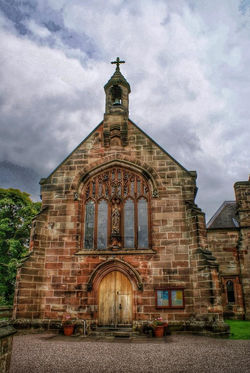
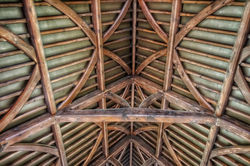
St John’s Church was constructed between 1840 and 1842 as part of the Alton Castle and hospital complex of buildings created by Pugin for the 16th Earl of Shrewsbury. Pugin designed St John’s church to provide not only a place of worship but also a place of education for the less fortunate children of the village. It was designed so the church could be divided in two, with the nave doubling up as a schoolroom and the pulpit as the schoolmaster’s podium. The benches also had hinged flaps, which enabled them to be raised and converted to desks, and rather than use tiles on the floor, Pugin insisted on wood, which would be warmer in winter for the children, who often went without shoes.
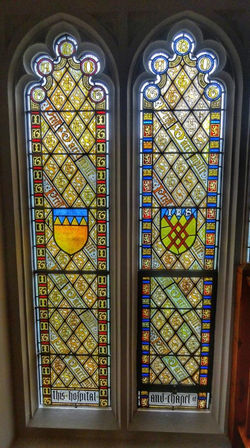
The windows in the nave were made by Thomas Willement and bear the armorial devices of the Verdun, Neville and Furnival families as well as the Earl’s family motto, ‘Prest d’ Accomplir’ in diagonal bands. Willement was born in St Marylebone, London, in 1786 and was one of the most successful stained-glass producers of the 19th century. As such, he was duly dubbed the Father of Victorian Glass. Like Pugin he was passionate about the true principles of medieval craftsmanship and encouraged the return of methods such as using lead to emphasise the outline of designs. Whilst they shared many views it was, however, over of the windows of St John’s that Willement and Pugin went their separate ways, the latter accusing the former of overcharging for the work.
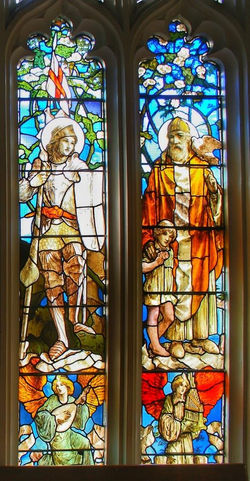
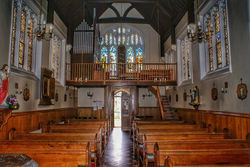
At the west end is a gallery and above it a window by Paul Woodroffe. Both of

these elements are, however, later additions and were not part of Pugin’s original design.
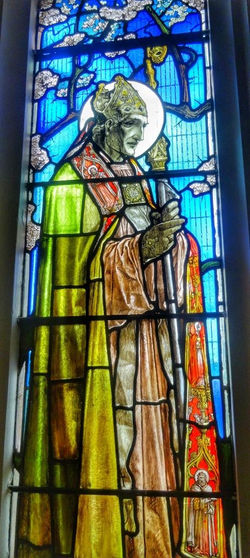
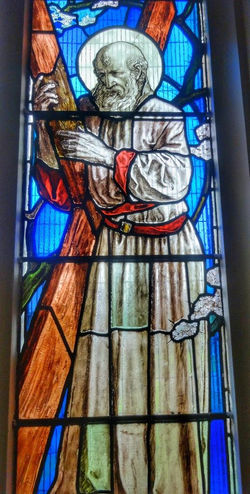
Woodroffe, a student at the Slade School of Fine Art in Bloomsbury, was a prominent artist in the Arts and Crafts movement and illustrated a number of books, including Songs from the Plays of Shakespeare. From illustrating books he went on to work with stained glass, incorporating his distinctively Pre-Raphaelite style into his designs. In the late 1800s Woodroffe, along with another family, the Morrat’s, lived in Alton Castle and the west window at St John’s was his first commission of glass. The window depicts the patron saints of England, Ireland, Scotland and Wales.
-01.jpeg)
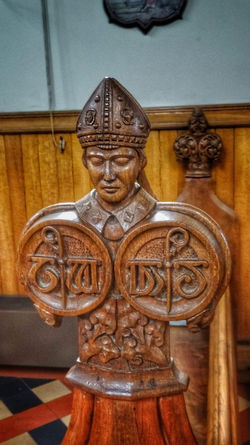
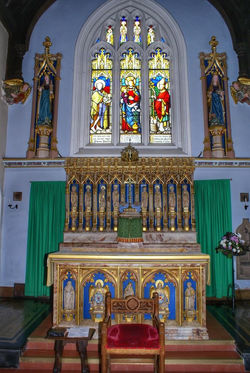
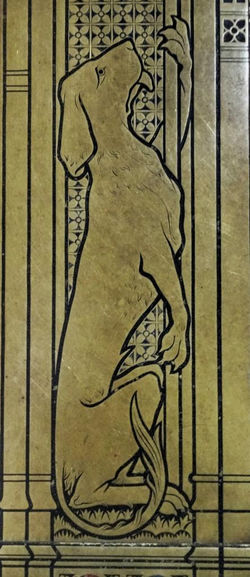
In the chancel there are several lovely examples of poppy head benches which are carved with Shrewsbury lions, a bishop and various types of symbols, flora and fauna. The east window, above the finely carved alabaster altar and reredos by Thomas Roddis, is another work of Willement which depicts St John the Baptist, the Madonna and Child and St Nicolas. Either side of the sanctuary are large brass memorials, designed by Pugin’s son Edward, marking the burial sites of the 16th Earl and his countess and the 17th Earl, Bertram Talbot.
At first glance St John’s might seem somewhat plain in comparison to the likes of nearby St Giles, but it should be remembered that it too had once been richly stencilled and sported an intricate rood screen, the crucifix of which still remains in the chancel. And whilst it maybe small it is nonetheless a glorious little church.
If you would like to learn more about St John’s and Pugin’s work in and around Alton,
I thoroughly recommend reading Gothic Forever by Michael Fisher.
 |  |  |
|---|---|---|
 |  |  |
 |  |  |
 |  |  |
 |  |  |
 |  |  |
 |  |  |
 |  |  |
 |  |  |
 |  |  |
 |  |  |
 |  |  |
 |